The PASSION for the PLANET blog has now moved to a new home - PASSION for INSPIRATION.
PASSION for INSPIRATION is our new online magazine site - you'll find 100s of articles, features, blogs and top tips from a range of experts.
Choose from...
Environment
Ethical Living
Ethical Wealth
Healthy Living
Inspiring Business
Lifestyle
Personal Growth
Radio
Spirituality
Fitness
Generating Your Own Energy
Peace Building
Global News
You can also subscribe to our RSS feed via the site, or type the URL into your google reader to ensure you never miss a new posting. We're updating it all the time - so there's always something new to come back for!
If you prefer to listen rather than read, then visit our audio on-demand site - PASSION for FRESH IDEAS.
You'll find 100s of interviews with leading experts...
Animals
Environment
Ethical Living
Ethical Wealth
Frontier Science
Healthy Living
Inspiring Business
Peace Building
Personal Growth
Spirituality
World Affairs
Global News
View from Fes
Book Club
Canada
Changing Your Body
Fes Festival
Fitness and Training
Florida
Lynne McTaggert
Sign up for free, then listen on-demand, when it suits you.
Listen to PASSION for the PLANET radio
Listen to interviews on-demand at PASSION for FRESH IDEAS
Read articles from leading experts at PASSION for INSPIRATION
Showing posts with label health. Show all posts
Showing posts with label health. Show all posts
Tuesday, 17 August 2010


Saturday, 3 April 2010
Lower your blood pressure by eating Chocolate

Good news – it’s Ok to eat those delicious Easter eggs this weekend – provided you do so in moderation. That’s according to the latest research.
A recent study, published in the European Heart Journal, looked at over 19,000 people and found those who ate half a bar a week had lower blood pressure. And that’s not all - they also had a 39% lower risk of heart attacks and strokes.
The study, over an eight year period, looked at the chocolate consumption of middle-aged men and women. It compared the health of those who ate the most and least chocolate.
The difference between these two groups was just six grams a day, equivalent to one small square of chocolate a day.
Dr Brian Buijsse, from the German Institute of Human Nutrition, Nuthetal said: "Our hypothesis was that because chocolate appears to have a pronounced effect on blood pressure, therefore chocolate consumption would lower the risk of strokes and heart attacks, with a stronger effect being seen for stroke."
And rather handily for those that love chocolate that is exactly what the study found; those who ate more chocolate cut their risk of heart attacks by around a quarter, and of stroke by nearly half, compared with those who ate the least.
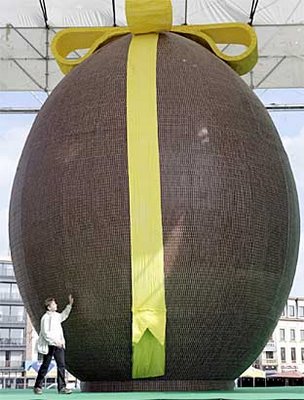 "Small amounts of chocolate may help to prevent heart disease, but only if it replaces other energy-dense food, such as snacks, in order to keep body weight stable," added Dr Buijsse.
As usual dark chocolate is considered better than milk chocolate, as the researchers believe that flavanols in cocoa may be the reason why chocolate seems to be good for blood pressure and heart health, and as there is more cocoa in dark chocolate, dark chocolate probably has a greater effect.
However heart campaigners are not convinced and have warned that too much chocolate is damaging because it is loaded with calories and saturated fat, which are linked to weight gain and raised cholesterol levels; two of the key risk factors for heart disease.
For more healthy tips and good news, listen to PASSION for the PLANET
Tuesday, 30 March 2010
How a Haystack can help heal your back

Got bad back? Go crawl in a haystack
Hay, water, a large plastic bag and a wooden platform – this the modern way of having a hay bath.
100s of years ago when famers in the Tyrolean Alps had a sore back after a hard day in the fields they would crawl inside a hay stack, lay down and wait for the healing powers of the meadow herbs and the heat generated within the stack, to heal them.
However for those of us without a handy hay stack in the back garden there is an alternative – a hay bath. tried one at the Wiesenhof Hotel in Pertisau in Tyrol, Austria.
You lie on a wooden platform in a large bath. But rather than lying in water, you are actually floating on top of a large plastic bag filled with water – so it’s a watery sensation without the wetness. You are then covered in damp hay, which is considerably less prickly than dry hay. A damp sheet is wrapped around you and a number of towels and blankets keep you warm.
Once you are ready the platform is lowered away and you “float” in the encased water. There is a feeling of weightlessness and the mind and body begin to relax as the water heats up from 38 degrees to around 41 degrees.
 For the next 25 minutes you lie floating in a bed of warm hay and meadow herbs. It’s quiet. It’s comforting. It’s relaxed. You’ll probably fall asleep.
The heat encourages you to sweat and the herbs help pull out toxins. The combination causes the muscles to relax and spasms to reduce.
I was quite disappointed when my time was up – I would happily have stayed there for much longer, cocooned in the warmth and breathing in the light scent of cut grass and wild flowers.
Like the majority of treatments at the Wiesenhof, the hay bath uses a local resource. The hay is grown in the mountain meadows and is cut by hand before being dried. Along with mineral salts and Stone Oil it’s a treatment that is unique to the local area and steeped in tradition.
So next time you mow the lawn remember that grass is good for more than just sitting on.
You can hear more about the natural treatments at the Wiesenhof in Tirol, Austria on PASSION for the PLANET
Tuesday, 9 March 2010
How I became obsessed by a dirty Malteser and lost 7lbs

I can’t take my eyes off the Malteser lying on the floor of the train carriage. All my brain can think is how much I’d like to eat it.
I am on week two of The BeautifulBreak Detox. I haven’t had any chocolate for 10 days and I am becoming obsessed.
Fortunately I have a little bag of delicious healthy treats to prevent me from doing something daft – like eating that damn Malteser.
The BeautifulBreak Detox is designed to help cleanse the body, flush out toxins, reduce stress on the digestive system and re-alkalise the body. Most of us have sluggish digestive systems, our bodies are acidic (which can lead to a range of health issues), we’re dependent on caffeine or nicotine and crave sugary or salty foods.
None of these are great for feeling your best.
The trouble is, detoxing always sounds so difficult – and a bit painful. But as detoxes go this is really very easy. They provide all the food for you – the meals, the snacks, drinks and even daily treats known as “detox temptations”. These are a selection of fruity flapjacks or little fruit cake balls – delicious.
In addition you do a lot of sweating.
Five times a week I head to BodyWorksWest for my wrap. Naked, apart from a pair of those “oh so flattering” disposable pants, I lie down on a damp sheet and the practitioner, Ilona Wesle, surrounds me with temperature controlled hot water bottles and then wraps me up in layers of blankets and towels until I look like some sort of fat Egyptian mummy, with just my face poking out at the top. And there I stay for about an hour – sweating in places I didn’t even know I could sweat. I sweat so much I begin to wonder if one day she will unwrap me and I will have completely melted!
I am on week two of The BeautifulBreak Detox. I haven’t had any chocolate for 10 days and I am becoming obsessed.
Fortunately I have a little bag of delicious healthy treats to prevent me from doing something daft – like eating that damn Malteser.
The BeautifulBreak Detox is designed to help cleanse the body, flush out toxins, reduce stress on the digestive system and re-alkalise the body. Most of us have sluggish digestive systems, our bodies are acidic (which can lead to a range of health issues), we’re dependent on caffeine or nicotine and crave sugary or salty foods.
None of these are great for feeling your best.
The trouble is, detoxing always sounds so difficult – and a bit painful. But as detoxes go this is really very easy. They provide all the food for you – the meals, the snacks, drinks and even daily treats known as “detox temptations”. These are a selection of fruity flapjacks or little fruit cake balls – delicious.
In addition you do a lot of sweating.
Five times a week I head to BodyWorksWest for my wrap. Naked, apart from a pair of those “oh so flattering” disposable pants, I lie down on a damp sheet and the practitioner, Ilona Wesle, surrounds me with temperature controlled hot water bottles and then wraps me up in layers of blankets and towels until I look like some sort of fat Egyptian mummy, with just my face poking out at the top. And there I stay for about an hour – sweating in places I didn’t even know I could sweat. I sweat so much I begin to wonder if one day she will unwrap me and I will have completely melted!

The wraps are designed to increase peripheral circulation and stimulate the metabolism to eliminate waste products and toxins. According to Ilona, this is not just good for your health, it can also help to reduce cellulite. A definite bonus.
During the first few days I found the food very bland and longed for some flavour, but within less than a week my taste buds had adjusted and each meal was tasty and bursting with flavour. It just goes to show how so much salt in the diet and in the body can affect how we taste and experience our food.
After three weeks, my skin is softer and smoother, my stomach is flatter, I’ve lost nearly 7lbs and my thighs are cellulite free.
It’s one of the easiest detox plans I’ve tried – the wraps may be time consuming but they are also an excellent excuse to relax and meditate, sleep or enjoy an audio book. The food is tasty and well thought through with plenty of variety (the Thai green curry was my favourite), and the detox temptations are delicious. They are so good I’d happily eat them even when I am not on health kick.
And, despite my obsession you’ll be pleased to know I didn’t succumb to any dirty Maltesers!
You can hear more from Ilona Wesle from Beautiful Break Detox on PASSION for the PLANET.
Friday, 18 December 2009
How my job changed my life and my health
 I’ve been with Passion for the Planet for over a year now. Did I see myself working here a year? The short answer, to begin with, was no.
Let me explain. I didn’t apply for the job. I didn’t want a job in media and I wasn’t environmentally friendly. I wasn’t a complete eco hazard – I recycled bottles and clothing, and would walk instead of drive when possible. Although, if I’m honest this was because pre-Passion for the Planet I was a student and a lot of my ‘greener’ actions were fuelled by the knowledge it would save me money – it turns out that a good sale & buy on eBay can pay for next week’s food, that energy saving light bulbs cut electricity bills and that parking on campus costs a small fortune.
However, during my university years I also committed various environmental crimes. I drove up and down the M1 between London and Leicester, threw scrunched up scrap paper from essays in to bins rather than recycling and our diets were definitely not doing anybody any favours, including ourselves.
If a student gives you the excuse that they eat rubbish because they don’t have money for food – they’re lying. We used to buy take-aways a couple of times a week and eat burgers on the way home after nights out. These burgers were grim to say the least, being known universally among my friends as ‘rat burgers’ (the owner of the van used called us the ‘ratty girls’ as he never worked out we were referring to his business). We evened these expenses out by buying noodles that cost 5p per pack (I’m not joking, see here and sort the results in ascending order - they’ve gone up to 9p now). Apart from the fact they probably have about the same nutritional value as the newspaper you read this morning and forget the carbon footprint for a second - I still can’t get my head around how they could afford the entire manufacturing process from buying the ingredients, to cooking them, packaging and driving them to the supermarket all for just 5p.
Anyway, I know I wasn’t the only one eating like this. In fact, with regards to health, I was still slim as I would run around the park to work off the night before, and I was even relatively fit because I played a lot of sport for the badminton and hockey team. The fact that I was at the top end of the health scale compared to my peers says a lot about the benefits of exercising (or their lifestyles)!
So how did I get a job at the UK’s only environmental and health focused radio station without lying or even applying??
Well, the radio station was becoming more popular and expanding, so quickly in fact that it was keen to find some support staff. I happened to be at a friend’s house after graduating, discussing how I needed a job quickly to save up for travelling so I could go and come back before getting myself on to a graduate scheme. Her mother overheard and suggested Passion for the Planet, even though they hadn’t started advertising any positions yet. She said she wasn’t sure if it was what I was looking for (or even if I was what they were looking for) but maybe it would suit both parties for a while. So after a short interview that established I was capable of helping with admin and would fit in at the office, I got the job. As I only intended to stay for about 6 months before leaving to go travelling it was also agreed that they would continue to look for someone who would grow with the business.
As I began working at Passion for the Planet, I would also be listening to the radio at the same time as working. The interviews meant I quickly picked up hundreds of tips and lots of advice – not just on how to live a healthier lifestyle but a more environmentally friendly one too. Although I had never made any conscious effort to change my life, as I tuned in it just seemed to happen naturally.
By listening to the station I gained insights into a whole range of topics from cutting down office waste, to training falcons, where I can shop ethically and how to get into business. And my education was absolutely effortless too. Not to mention free!
Now, although I still own a car I certainly use it less. Even the smallest changes have made such a difference, from the way I eat (although I’m not a full blown vegetarian I am definitely feeling the benefits of eating less meat) to using websites like Freecycle to keep my flat tidy. The health tips have left me feeling more energetic and the inspiring good business interviews have made me reconsider my career path. Now I know there are so many more options available to me than just joining a graduate scheme! Reusing or reducing what I use has not only cut down waste but has saved me money which went towards my travels. (Passion for the Planet kindly kept the job open for me to allow me to fulfil my dream of travelling for 5 months, in the knowledge that I had a full time job to come back to.)
Passion for the Planet’s aim is to inspire and motivate people to live a healthier, greener life by giving them useful information in an entertaining way.
I’m proof that what we’re doing is making a difference!
Wednesday, 11 November 2009
Camley Street, King’s Cross – A Sustainable Vision
 Alex Smith is the founder and MD of Alara Wholefoods – one of the UK’s biggest organic muesli manufacturers who are based in the heart of the capital at King’s Cross.
I love gardening, but more than that I love to grow food, and in this day and age when we spend so much money on food in the UK and yet there are people starving across the world I believe that we must move towards a society where we all grow our own.
It is all linked to the matter of fuel and moving from a non sustainable fossil fuel reliant society to a sustainable one who ‘welcomes the sun’ and harnesses alternative energy sources.
My food manufacturing company Alara Wholefoods is based right in the centre of London, the King’s Cross hub where historically there have been a huge amount of important social and economic developments throughout history. For example St Pancreas Old Church, which is based just down the road from me, is one of the earliest above ground Christian Churches in Europe, and near here at Battlebridge Queen Boadicea was finally defeated by the Romans, or so it is said…
Most importantly, I feel, for the development of London into one of the world’s greatest capital cities, was the completion of the Grand Union Canal in 1780 which allowed grain to be brought into the heart of the city via the River Fleet. Just down from Alara is Granary Street where the grain that was brought in along this water way would have been used to make bread and feed the growing population.
I feel this was one of the most important historical events for London as the growth in population to over 1 million people in 1785 (the second city to get to this size after Ancient Rome) led to an overall change in the structure of society. Governmental infrastructure was put in place and subsequently the Industrial Revolution, and from that the British Empire grew – all based on the ability to provide food for the fast expanding population.

Looking around this historical area nowadays I find myself becoming disheartened as to what has become left from the ‘green and pleasant land’ of the past that Blake wrote about in his famous poem. He lamented that the post industrial revolutions ‘dark Satanic mills’ were now covering the landscape, but amongst all the development and business I can see areas that could be green and pleasant once more….
My point is that here at the Kings’ Cross hub, which in my opinion was where London entered into the unsustainable industrial age, it is a perfect place to start to move to ‘Welcome the Sun’ and towards a more sustainable society. And it all comes full circle back again to food. Where once grain barges came to Granary Street to feed the population who worked to make industry great, now it is food that once more needs to be at the forefront of the change the way our society works.
All my business life has been about food, but more importantly organic food. I make muesli and at Alara we produce over 70 tonnes a week. I find it so crazy these days that so many people have no real concept of growing food, good nutrition, healthy eating – we live such a consumer way of life where the supermarkets supposedly have all we need and we don’t think twice about growing our own.
At Alara I decided to make my own Permaculture Forest Garden – Permaculture being the theory of using the space you have to produce the highest yield of crops. It took the removal of 50 tonnes of rubbish (the finest King’s Cross had to offer!) and the dreaded Japanese knotweed! I love my garden and found this year that I didn’t have to buy any fruit for me and my family – I always sit out there and eat my muesli in the morning looking at what we have achieved, whist hearing the roar of the express trains rushing by – my very own piece of green and pleasant land..
But it hasn’t stopped there; looking around the edges of the factory I kept noticing bits of land and thinking what we could do with them. Now we have London’s biggest inner city organic vineyard, and also a Community food garden with Camden Black and Minority Ethnic groups that is really thriving.
There are so many places that are wasted, so much potential for food growing for local communities, and all it takes is a bit of hard work and passion. There really is nothing better than eating something you have grown yourself….
A few weeks ago (Sunday October 18th) we held the Camley Street Apple Day which attracted over 250 people. The day was a fantastic celebration of that most English of fruits – the apple and much fun was had by all. It was also a way to bring people from the local area, community groups and organisations together to show them of the projects we have been undertaking already, to start a new project with our neighbours Booker Cash and Carry, and to look to the future of the Camley Street area.
Firstly the BME garden was opened by the Mayor of Camden who praised the hard work of the community groups who now are able to use the raised beds to grow produce for their community canteens. Many of the people in these groups used to grow their own produce before they came to London but are now without the space to do so, and so it is fantastic to see their growing knowledge and expertise coming to life once more.
Next we planted an Orchard in conjunction with our neighbours Booker Cash and Carry on land that up to now has been a grassy strip. Now it has a new, much more fruitful purpose.

Lastly I was able to introduce my Sustainable Vision for Camley Street and the surrounding area. As I mentioned there is so much land up and down Camley Street that is going to waste; it’s nasty, overgrown, dirty, dumping ground. So much could be done that would not only improve the look and feel of the place, but would also give rise to huge areas of food producing land for local businesses, communities and social enterprise. I think the people really got it, they saw what can be achieved with a bit of planning and some hard work but as always the more the merrier and when you have a group of you involved in planting an digging it is always easier to achieve your goal.
I have big plans for this area. We are currently moving forward with planning permission and funding for a small community scale Anaerobic Digester (the first of its kind in Europe) which would produce tonnes of digestate for these areas that I see in the area, and really help these small projects to get off the ground.
In summery there’s a huge amount of potential here, and I know this is the same all across the capital. Food is the most important commodity and we often really take it for granted, but I hope that we can all start to grow our own and reap the benefits of doing so.
For more information about the Camley Street vision and Alara please visit Alara's website.
Thursday, 22 October 2009
Preventing Health and Environmental Catastrophes

Gordon Brown warns of 'catastrophe' if no climate change deal is reached in Copenhagen in December
British Prime Minister Gordon Brown has warned of a 'catastrophe' of floods, droughts, and deadly heatwaves if world leaders don't agree a climate change deal this December. In a speech to the Major Economies Forum in London, which you can see below, Mr Brown has insisted there is no 'plan B' if agreement isn't reached at December's UN climate summit in Copenhagen. The Copenhagen talks aim to produce a successor to the Kyoto climate treaty, but preparatory discussions at the UN are stalled. The British government's critics say it is not doing enough on climate change and is in no position to lecture the rest of the world about it. Olly Barratt reports.
Drugs campaigners on benefits/dangers of prescribing heroin to addicts
I've just filed a package for on the recently published preliminary findings of a UK trial which has seen heroin addicts given the drug in an attempt to cut crime and help them deal with their addiction. It's an idea that's been the reality for some time in Switzerland but arouses strong emotions from people who support it, and those who oppose it. I've been speaking to Mary Brett from drugs campaigners Eurad, who is against moves to roll such a plan out in the UK - and you can listen to part of our discussion here as Mary tells me it's not a good idea. I've also been speaking to Claudia Rubin from drugs charity Release - you can listen to some of our interview here - she supports moves to a Swiss-style system following the 'success' of the UK trial.
Olly Barratt - UK correspondent.
FSN is PASSION for the PLANET's award winning news partner, providing global news from bureaus worldwide.
You'll find more from world news stories, plus analysis from FSN at FSN REPORTERS BLOG.
British Prime Minister Gordon Brown has warned of a 'catastrophe' of floods, droughts, and deadly heatwaves if world leaders don't agree a climate change deal this December. In a speech to the Major Economies Forum in London, which you can see below, Mr Brown has insisted there is no 'plan B' if agreement isn't reached at December's UN climate summit in Copenhagen. The Copenhagen talks aim to produce a successor to the Kyoto climate treaty, but preparatory discussions at the UN are stalled. The British government's critics say it is not doing enough on climate change and is in no position to lecture the rest of the world about it. Olly Barratt reports.
Drugs campaigners on benefits/dangers of prescribing heroin to addicts
I've just filed a package for on the recently published preliminary findings of a UK trial which has seen heroin addicts given the drug in an attempt to cut crime and help them deal with their addiction. It's an idea that's been the reality for some time in Switzerland but arouses strong emotions from people who support it, and those who oppose it. I've been speaking to Mary Brett from drugs campaigners Eurad, who is against moves to roll such a plan out in the UK - and you can listen to part of our discussion here as Mary tells me it's not a good idea. I've also been speaking to Claudia Rubin from drugs charity Release - you can listen to some of our interview here - she supports moves to a Swiss-style system following the 'success' of the UK trial.
Olly Barratt - UK correspondent.
FSN is PASSION for the PLANET's award winning news partner, providing global news from bureaus worldwide.
You'll find more from world news stories, plus analysis from FSN at FSN REPORTERS BLOG.
Tuesday, 13 October 2009
Tell the chef to cook something proper!

“Oh for goodness sake, tell the chef to cook her something proper!”
I was so thrilled to hear this that I nearly leapt out of my chair and did a little dance of joy.
I was so thrilled to hear this that I nearly leapt out of my chair and did a little dance of joy.
Why was I so thrilled? Well, I have this issue with pasta and risotto as the unimaginative de facto standard vegetarian option in pretty much every restaurant I ever visit.
So when I was invited to stay for lunch at C Restaurant in Vancouver while interviewing Executive Chef Rob Clarke, I explained that I didn’t eat meat or fish. The waiter started to suggest their one vegetarian option – the pasta. It was at this moment that Mr Clarke uttered the words I was so delighted to hear.

And what the chef came up with was amazing. Why it wasn’t on the menu already and why they chose tedious pasta instead, I cannot imagine.
My meal started with tiny bites of marinated fruits and vegetables on skewers. They were served standing upright on a glass tile, looking like multi-coloured flags of food. The main course was essentially “British Columbia on a plate”. The chef personally delivered it to my table and explained each item and where it had come from in the province. It seemed there was a delight on offer from almost every area, laid out on the plate like a work of art and with a good balance of vegetables and protein (unlike pasta or risotto which generally only contains carbohydrates and fat).
My meal started with tiny bites of marinated fruits and vegetables on skewers. They were served standing upright on a glass tile, looking like multi-coloured flags of food. The main course was essentially “British Columbia on a plate”. The chef personally delivered it to my table and explained each item and where it had come from in the province. It seemed there was a delight on offer from almost every area, laid out on the plate like a work of art and with a good balance of vegetables and protein (unlike pasta or risotto which generally only contains carbohydrates and fat).
It just goes to show; this chef was far better than pasta. It’s a shame that so often vegetarians (or meat eaters who fancy a day off) are palmed off with sub standard fare. And Rob Clarke’s comment makes me wonder if in fact they are aware of this but perhaps choose the safe (lazy?) way out on their menus.
My plea to chef’s everywhere is don’t treat vegetarians as second class diners.
My experience of vegetarian food in British Columbia was generally excellent. I also visited (along with eight meat eaters) a seafood and sushi restaurant called Blue Water and we all tried a taster menu. Each course was beautifully presented and explained and wine chosen specifically to complement it. Quite often as a vegetarian I feel that I am missing out on the care and attention that a chef gives to meat eaters. Not so here. My food was carefully thought through, artfully presented and deliciously tasty.

I spoke to quite a few chef’s during my trip and needless to say we ended up having “the vegetarian conversation” (it seems to have become impossible for me to eat out without being asked why I am vegetarian, and do I find it difficult and do I miss meat, and what do I eat... ? etc). Each chef told me that if I didn’t like what was on the menu I should ask the chef to make me something else. They assured me that every decent chef has plenty of vegetables in the kitchen and can easily make a meat free meal that doesn’t involve pasta or risotto.
I’d been given similar advice by British chefs too, so when I recently visited the Cadbury House Hotel in Yatton I was ready to put it to the test. Cadbury House is a gorgeous hotel with a boutique feel. The decor is modern, elegant and a touch quirky. The spa is luxurious and the gym is well equipped. And the group manager Mark has some great tales to tell that will keep you entertained if you are lucky enough to get a chance to share a drink with him.
The restaurant prides itself on including plenty of local produce on the menu and I was looking forward to dinner and an imaginative vegetarian meal. Predictably the dish on offer was risotto, but that didn’t worry me as I was armed with my advice to ask for something else. Unfortunately it didn’t quite work as planned.
My main meal was a selection of the vegetable side dishes, which would have been OK (although I did feel a little as though I’d been palmed off with an “I can’t be bothered” meal) except for the fact it had large chunks of bacon in it! I think it’s fair to say they hadn’t taken any time to think about what they were serving me. Once again, a sad indication of the attitude of many chefs towards vegetarians.

There are of course plenty of exceptions. One such is The Harbour Cafe in Margate. This is a small seafront bistro that does the best Sunday lunch nut roast I have ever had. And it comes with all the trimmings of a traditional roast dinner. It’s worth going to Margate just for that. I’d also recommend that you save desert for a trip to the bandstand cafe on the beach and have a freshly cooked donut Brown Derby. Delicious.
Friday, 4 September 2009
I don’t just like my allotment – I love it.

40 years to wait for an allotment – that’s what the headlines shouted recently.
In fact, on closer inspection, it’s not entirely true but it is interesting that allotments are in more demand than they have been since the post war years of the late 1940s and 50s.

I am lucky enough to have an allotment at a very well run site called The Paddock. I’ll be honest, for the first couple of years, when I was trying to cope with it on my own, it was really too much. An allotment takes time and energy and the tiny bit of each that I was able to dedicate to my plot meant that come harvest time I was pulling weeds not vegetables.
So about a year ago I asked a friend if she’d like to share it with me –and the difference has been astounding.

I’d always enjoyed working on the plot, but now, with a friend to chat to and to be able to share the successes and failures, I don’t just like it, I love it.
And I am no longer harvesting weeds. Instead we’ve had (and are still having) punnets of raspberries, handfuls of giant courgettes, delicious French beans, onions, cabbages, sweet golden tomatoes, rhubarb and crunchy carrots, with the promise of corn on the cob, pumpkins, beetroot, spinach, and leeks still to come.
Have I saved money? Overall, probably not.
Does the food taste better than supermarket fare? Most definitely yes.

Have I made friends? Yes and by being part of an allotment group I feel part of a community; something that seems to be increasingly difficult in the modern age and especially in a big city like London.
Will I be keeping my allotment next year? A huge and resounding; yes, yes, yes.

So what advice do I have?
1) If you haven’t already got an allotment and it appeals to you – put your name down now, most places do have a waiting list, fortunately it’s not generally 40 years, but be prepared to wait a year to 18 months.
2) Be prepared to work hard. But also be prepared to enjoy fresh air, the sound of birds singing, a connection with the land and strange conversations about blight and pruning and “how come yours are huge and mine are tiny?”
3) Share it with a friend; it’s more fun, less work, the yields tend to be higher, the highs and lows are shared and it can be great planning what to grow together and trying out each other’s favourite fruit and veg.To find out about allotments in your area you’ll need to call your local council. A good book to get you started is “The Essential Allotment Guide”.
Tuesday, 4 August 2009
Walking and Cycling

Getting ourselves from A to B can often have a negative impact on the planet. We all know that we should fly less, reduce our car use and use public transport wherever possible. The trouble is that most of these actions involve sacrificing something, and that doesn’t sound like much fun to anybody.
It can be hard to visualise actually enjoying and benefitting from reducing your personal transport emissions when you are being made to feel guilty. However, if we did all walk or cycle a bit more, we would be healthier and better off, the planet would benefit, and we’d probably be a whole lot happier as a result.

With this in mind I’d like to recommend some websites and ideas that aim to make cycling and walking both more accessible and more desirable (and do it pretty well in my opinion).
The first website is all about walking. Walkit.com is like a journey planner for walking. You input your starting point and destination and the site will generate a route for you, complete with map and instructions. You can see how far the journey is, how long it should take for fast, medium and slow walkers, how many calories you’ll burn and the carbon emissions you will save when compared with making the same journey using another form of transport. Best of all you can choose between direct, less busy or less polluted routes. The latter will avoid main roads and go through parks and along rivers, giving you a more pleasant and healthier option for your journey. Walkit currently covers a variety of UK cities and there are plans to launch it in many more over the coming months. Check it out; you’ll be surprised at how quickly and easily you could get to your destination without spending a penny and both doing something healthy and benefiting the planet in the process.
Moving on to cycling (and I’m afraid this is specifically London based – apologies to any non-Londoners), transport for London has recently launched the new cycling section of its website and it’s packed full of useful information for cyclists of any proficiency. You can access information on cycle routes (including green routes), cycle training, equipment, safety and when you can take your bike on public transport. It’s a great resource and one that will expand as new routes are added. If you are the kind of person who likes the idea of cycling more but lacks the confidence to bite the bullet and do it, then you will find loads of tips to get you excited about getting on your bike. More experienced cyclists will benefit from the cycle journey planner and alternative routes that are available.
The first website is all about walking. Walkit.com is like a journey planner for walking. You input your starting point and destination and the site will generate a route for you, complete with map and instructions. You can see how far the journey is, how long it should take for fast, medium and slow walkers, how many calories you’ll burn and the carbon emissions you will save when compared with making the same journey using another form of transport. Best of all you can choose between direct, less busy or less polluted routes. The latter will avoid main roads and go through parks and along rivers, giving you a more pleasant and healthier option for your journey. Walkit currently covers a variety of UK cities and there are plans to launch it in many more over the coming months. Check it out; you’ll be surprised at how quickly and easily you could get to your destination without spending a penny and both doing something healthy and benefiting the planet in the process.
Moving on to cycling (and I’m afraid this is specifically London based – apologies to any non-Londoners), transport for London has recently launched the new cycling section of its website and it’s packed full of useful information for cyclists of any proficiency. You can access information on cycle routes (including green routes), cycle training, equipment, safety and when you can take your bike on public transport. It’s a great resource and one that will expand as new routes are added. If you are the kind of person who likes the idea of cycling more but lacks the confidence to bite the bullet and do it, then you will find loads of tips to get you excited about getting on your bike. More experienced cyclists will benefit from the cycle journey planner and alternative routes that are available.

Sticking with cycling (and also with London again – sorry!), I wanted to draw attention to a couple of future developments that have got me really excited. The first is the 12 ‘cycling superhighways’, planned for completion by 2012. These will be dedicated cycle ways from the outer boroughs into the centre of London. The new routes will by clearly marked with continuous cycle lanes at junctions to help keep cyclists safe. I’m sure that these routes will make a lot of people feel much more confident about cycling in London.
The second is the Cycle Hire scheme planned for launch in May next year. This is similar to the Vélib scheme in Paris and will allow people to pick up a bike from a docking station and return it to another docking station at their destination. This will be really useful to both commuters and tourists. Initially there will be around 6,000 bikes in Central London and I suspect that this number will increase quickly as the scheme grows in popularity.
So there you have it. Just a few helping hands to make walking and cycling seem like more desirable options. Leading a healthier and more sustainable life is about increasing your quality of life, rather than simply sacrificing the things you need, want and enjoy.
Subscribe to:
Posts (Atom)
